

CATEGORIES:
Tornado Shelter Liability For Businesses: What Risks Do You Face?
November 10, 2025
You want to know what tornado shelter liability for businesses really looks like–because leadership, insurers, or maybe even your gut is asking if the risk is worth the cost. What are your obligations? The short version: liability from tornadoes, or other severe weather events, flows through three channels: OSHA enforcement, employee injury systems, and civil suits from customers, visitors, or the community. Your exposure hinges more on planning, training, warnings, and site decisions than on the existence of a purpose-built shelter alone. Preparedness matters.
Why does this matter today? Because tornado warnings don’t stay hypothetical for long in wind zones. Sirens sound, NOAA radios squawk, phones buzz, and decisions move from binder to real life. If the team wanders in confusion while the front doors stay open and customers linger under skylights, you feel the risk in your stomach and possibly in court later.
Let’s map the business liability for tornados, then give you a defendable playbook. Fair, specific answers, and built for zero-regret decisions.
Tornado Shelter Liability for Businesses: What You Face Without a Shelter
Businesses face tornado-related liability through OSHA citations for safety failures, workers’ compensation claims for employee injuries, and premises liability lawsuits from customers, vendors, and the public. The presence of a tornado shelter reduces but does not eliminate this exposure if planning, training and overall organization fall short.
Think in channels, not silos. A business can pass code on day one, then face enforcement and lawsuits after a storm if managers ignore warnings or send people into glass-lined spaces, where debris could be an issue. On the other hand, a business can lack a purpose-built safe room and still defend its actions if supervisors promptly execute a solid shelter-in-place plan and provide documented training and other resources during a disaster. Providing information is of major importance.
Regulatory Enforcement Through OSHA
OSHA enforces the General Duty Clause and emergency planning rules when a recognized hazard, like a tornado, threatens workers and when reasonable protections are feasible. That means an Emergency Action Plan (EAP) that spells out monitoring, alerts, roles, sheltering procedures, and drills. If investigators arrive after injuries and find no written plan, no NOAA weather radio, no training, or doors kept open during a warning, citations follow. Serious violations carry five-figure penalties per item. Willful or repeated classifications multiply the pain and the headlines.
Picture the inspection walkthrough: a wall clock stopped at impact time. There are safety posters curling at the edges. Managers are searching for sign-in sheets that never existed. That’s how minor documentation gaps turn into major credibility problems.
Employee Injuries Under Workers’ Compensation
Employee injuries are usually covered by workers’ compensation for medical and wage benefits, which limits direct negligence suits against the employer in most states. That does not insulate the business from OSHA penalties or from contribution claims if third parties get sued. If conduct is egregious, like ignoring active warnings, locking interior doors, or ordering outdoor work during a warning, some states allow exceptions to the exclusive remedy rule. Insurers take notice either way, and premiums remember.
Civil Suits From Customers, Vendors, And The Public
If a customer or vendor gets hurt during a storm, premises liability laws will apply. Premises liability governs injuries to invitees such as shoppers, patients, clients, and visiting drivers. Plaintiffs argue foreseeability when the National Weather Service (NWS) issues a warning with minutes to act. They analyze your decisions: who made announcements, which doors were closed or opened, whether staff directed people to interior halls, and whether anyone encouraged customers to keep shopping under broad glass atriums. A shelter helps, but juries care most about reasonable steps in the moment.
“Act of God” defenses often fail if negligence increases exposure. Leaving crowds under skylights while a warning blared? Expect questions you don’t want to answer.
Key Insight: Courts and regulators don’t grade architecture; they grade choices. A basic interior refuge plan, executed quickly, beats a beautiful shelter no one can find under pressure.
How Workplace Safety Laws Treat Tornado Risks
Workplace safety laws treat risk from tornadoes as a recognized hazard that employers must address with a feasible EAP, training, monitoring for alerts, and prompt shelter-in-place instructions when warnings activate.
While people do think of OSHA when they think about employee safety, OSHA does not maintain a universal “build a shelter” rule for occupants of all private businesses. OSHA expects a plan that fits the risk. If you operate in High or Moderate Risk wind zones—like parts of Texas, Oklahoma, Kansas, and other tornado-prone areas of the United States—OSHA expects the plan to be more robust because foreseeability rises with the map.
What OSHA Expects To See In An Emergency Plan
The Emergency Action Plan, in plain language, lays out who monitors weather, how the business warns people, where everyone shelters, who checks accessible paths for ADA users, and how leaders confirm headcounts. Your EAP should:
- Name interior, windowless rooms with strong framing.
- Show routes on maps.
- Include shift-specific procedures and ADA paths.
- Be practiced in drills.
Drills matter because people default to habit, and the importance of practice becomes clear when seconds count. Without practice, crowds drift toward front doors and glass. You already know that picture: wind-driven rain blowing sideways through automatic doors, carts rolling on wet floors, and customers looking for someone in a vest to tell them what to do.
Training records, time-stamped alert logs, documented plans, and drill notes build a story that holds up. And that story wins inspections.
How OSHA Evaluates Feasibility And Foreseeability
After a storm, OSHA looks backward. Their enforcement hinges on two questions: Was the tornado hazard foreseeable enough to require action, and were reasonable protections feasible in your operation? Foreseeability is based on regional risk, NWS watches and warnings, on-site sky conditions, and previous events near the facility. Feasibility includes NOAA radios, mass notification systems, clear routes to interior rooms, and door-management procedures for big-box entries. If investigators find that supervisors had a 10-minute warning and still allowed people to stay under a barrel-vault skylight, where flying debris could cause injuries, OSHA may classify the violation as “willful.”
✅ FAQ: Does OSHA require tornado shelters for businesses?
A: OSHA does not impose a universal shelter construction mandate on private businesses. OSHA requires employers to address the recognized tornado hazard with a feasible Emergency Action Plan, training, monitoring for warnings, and shelter-in-place procedures that use safer interior areas. ICC 500 shelters are required only when state or local building codes mandate them for specific occupancies.
When A Missing Shelter Becomes Negligence
A missing tornado shelter constitutes negligence when a reasonable employer with a similar risk profile would have provided a purpose-built shelter or equivalent protection, and the business failed to implement feasible alternatives like interior refuge areas, training, and timely warnings.
Negligence follows a familiar path: duty, breach, causation, damages. Duty rises with risk. Breach shows up as no plan, no training, or choices that kept people under fragile roofs during warnings. Causation links those choices to injuries. Damages speak for themselves.
Risk Factors That Raise The Duty Of Care in Tornado Situations
Some operations simply carry a higher duty to plan. Think distribution centers with long-span roof bays, large retail floors under acres of metal deck, glass-heavy showrooms, and sites that host hundreds of people at once. Add vulnerable populations like dialysis clinics, elder care facilities, and schools, and the expectation climbs again. Prior local tornado strikes, past near-misses, or repeated warnings build notice. In practice, that means a plaintiff’s lawyer can open with a map showing three warnings in the past two years and security video of employees pushing racks away from a wall of windows while the sky turns that sickly green-gray.
What Courts And Regulators Consider Reasonable Standards
Reasonable does not mean perfect. Reasonable means supervisors receive alerts through two channels (for redundancy), front doors go to manual to stop automatic opening during sheltering, managers steer people toward interior restrooms and hallways, and someone accounts for each team. Reasonable also means accessible routes work for wheelchairs and walkers, not just a set of stairs behind a locked door. This approach, following FEMA P-361 guidance and ICC 500 standards and regulations, where applicable, shows diligence and organizational resilience, even if the building lacks a certified shelter. Code compliance sets the floor; it never guarantees the standard of care for every situation.
How Premises Liability Applies To Customers And Visitors
Premises liability for customers and visitors turns on whether the tornado danger was foreseeable in time to act and whether the business or organization took reasonable protective steps, such as issuing warnings, directing people to interior rooms, managing entrances, and avoiding exposure near glass, parking lots or other areas with a high probability of projectiles and debris.
Invitees are entitled to the highest duty of care. If an NWS warning hits phones at 3:42 p.m. and the public-address system stays silent, plaintiffs will run that clock back in slow motion. Lawyers reconstruct moments from security cameras: a mom pulling a stroller across a slick entry mat, a gust slamming the door open, a ceiling tile fluttering down. The question is simple: Why wasn’t everyone moved to the back hallway or the break rooms?
Vendors and contractors on-site fit a similar analysis. If a delivery driver parks under a metal canopy that tears off in high winds, expect questions about staging, signage, and the places where staff directed drivers to wait.
✅ FAQ: Do businesses have to let customers shelter inside during a tornado warning?
A: Businesses should move customers to safer interior areas when a tornado warning is active and the building has reasonable refuge space. Forcing people outside or keeping them under glass entries increases injury risk and liability. Clear announcements, door management, and staff guidance are the practical standard of care.
How Employer Liability And Workers’ Compensation Apply
Employer liability for employee tornado injuries runs primarily through workers’ compensation as the exclusive remedy, with narrow exceptions for egregious conduct. At the same time, OSHA enforcement can proceed independently, and third-party claims may involve landlords, contractors, or equipment makers.
Expect three parallel storylines after serious incidents: claim adjusters handling medical bills and wages, OSHA evaluating the plan and training, and attorneys mapping potential third-party responsibility. Dual employment arrangements add complexity for staffing agencies and host employers. Coverage usually attaches to the employer of record, but duties overlap.
Temporary workers deserve special attention. If a staffing partner supplies temps, the two businesses should align on training, routes, and headcounts. A temp left sweeping a glass atrium during a warning creates exposure for everyone involved.
Important: Do not send employees outside to “spot” or “film” storms. Assign no tasks that require exterior exposure once a warning triggers. Human life is worth more than a job. OSHA treats those decisions as unreasonable, and insurers may push back on coverage if gross negligence is alleged.
What Fines Or Penalties Apply For Tornado Safety Failures
Fines for tornado safety failures come from OSHA citations under the General Duty Clause or emergency planning guidelines when feasible protections were not in place. The maximum penalty amounts adjust annually, with serious violations in the mid–five figures and willful or repeat violations in the low–six figures per item.
For reference, OSHA’s 2024 maximums were $16,131 per serious violation and $161,323 per willful or repeat violation; the Department of Labor adjusts these numbers each January for inflation. A post-tornado inspection can surface multiple violations: no EAP, no training records, blocked interior routes, or failure to act on warnings. Multiply those line items, and the totals climb fast.
Repeat status matters. If the business was cited after a previous storm for missing EAP elements and did not verify abatement, the next citation can leap in class and cost. That’s a costly lesson for something as simple as running a 15-minute drill each quarter and keeping the sign-in sheet.
How Insurance Responds To Tornado Injuries And Lawsuits
Insurance responds to tornado losses through different policies: property insurance for building and equipment damage, general liability for customer injury suits, workers’ compensation for employee injuries, and umbrella layers for large claims, with indemnity hinging on alleged negligence, exclusions, deductibles, and documentation.
Property policies generally cover wind damage, subject to wind or hail deductibles that can be a percentage of insured value. Business interruption coverage may apply if the building sustains covered damage that shuts operations, but waiting periods and civil authority triggers matter. For injuries to customers or vendors, the commercial general liability (CGL) carrier defends negligence claims or legal action. Workers’ compensation addresses employee benefits and reserves. Umbrella policies sit on top when the limits of the underlying policies are exceeded.
Documentation preserves coverage and speeds up recovery. Time-stamped weather alerts saved on the server, training records, photos of refuge signage, and post-incident reports help the claims team build a defense. Without that record, adjusters face a blank page—and reserves grow.
✅ FAQ: Will a “natural disaster” exclusion bar coverage for tornado injury lawsuits?
A: Most CGL policies cover bodily injury caused by an “occurrence,” and a tornado does not erase negligence. Plaintiffs allege negligent decisions regarding warnings and sheltering. Coverage analysis looks at the alleged conduct, like company decisions, and policy exclusions, not just the storm itself. Work with counsel and your broker to tender early and preserve rights.
What Is Typically Covered Across Common Policies
General liability defends third-party bodily injury claims and pays settlements or judgments within limits. Workers’ compensation pays employee medical bills and wage benefits. Employers’ liability under Part B can respond to certain suits not barred by exclusivity. Commercial property covers buildings, tenant improvements, and contents against wind, subject to deductibles and sublimits. Time-element coverages, business interruption or extra expense, kick in only when triggers match policy language.
Common Gaps In Coverage And How To Close Them
Gaps hide in wind deductibles expressed as 2% or 5% of insured value, manuscript exclusions for named windstorms, or tenants relying on landlords for coverage they never verified. Close gaps by reviewing wind deductibles, demanding additional-insured status with primary and noncontributory wording for tenants or vendors, and checking that mass notification systems and NOAA radios are listed on risk engineering recommendations, then documented as completed. For vendor or landlord agreements, confirm indemnity clauses clearly assign tornado-related liability and don’t shift unintended exposure back to your company.
Documentation That Preserves Coverage
Think “receipts,” not memories. Save quarterly drill sign-ins, EAP review logs, screenshots of NWS warnings with time stamps, and photos showing refuge signs and door placards installed. Add a short after-incident report within 48 hours of any weather event that triggered a sheltering action, even if nothing was damaged. Adjusters love contemporaneous notes; juries do too.
What State And Local Shelter Requirements Might Apply
State and local requirements for tornado shelters usually target specific occupancies, like new schools or critical facilities in high-wind regions, through IBC adoption that references ICC 500. At the same time, most private businesses do not face a blanket mandate to build a shelter unless a local ordinance says otherwise.
Code adoption varies by jurisdiction and by edition. Several states adopting recent International Building Code versions require ICC 500–compliant storm shelters for certain Risk Category buildings, frequently K–12 schools and emergency response facilities, and critical infrastructure in mapped wind zones. Private warehouses, offices, and retail often fall outside explicit mandates unless local amendments extend the rule or a major renovation triggers new-construction provisions. The Authority Having Jurisdiction (AHJ) settles it, not a search result.
✅ FAQ: Do I have to retrofit an existing private building with a tornado shelter?
A: Most jurisdictions do not require retrofitting an existing private business with an ICC 500 shelter. Retrofit mandates are rare. New construction, additions, or occupancy changes can trigger shelter requirements for specific building types in certain wind zones. Always confirm with your local AHJ.
What Practical Steps Reduce Liability Without Building A Shelter
Practical steps that reduce tornado liability without building a new shelter include a written Emergency Action Plan, redundant alerting, trained supervisors, designated interior refuge areas with signage and resources, door and crowd control procedures, accessibility routes, and post-incident documentation. Even without basements, most buildings have safer interior rooms that can be reinforced and clearly marked for storm sheltering.
If you operate in a wind-prone area, decision speed saves lives and lawsuits. Think of it this way: you will never regret closing glass-heavy entries and moving people to interior rooms for 15 minutes. You might regret the opposite for years.
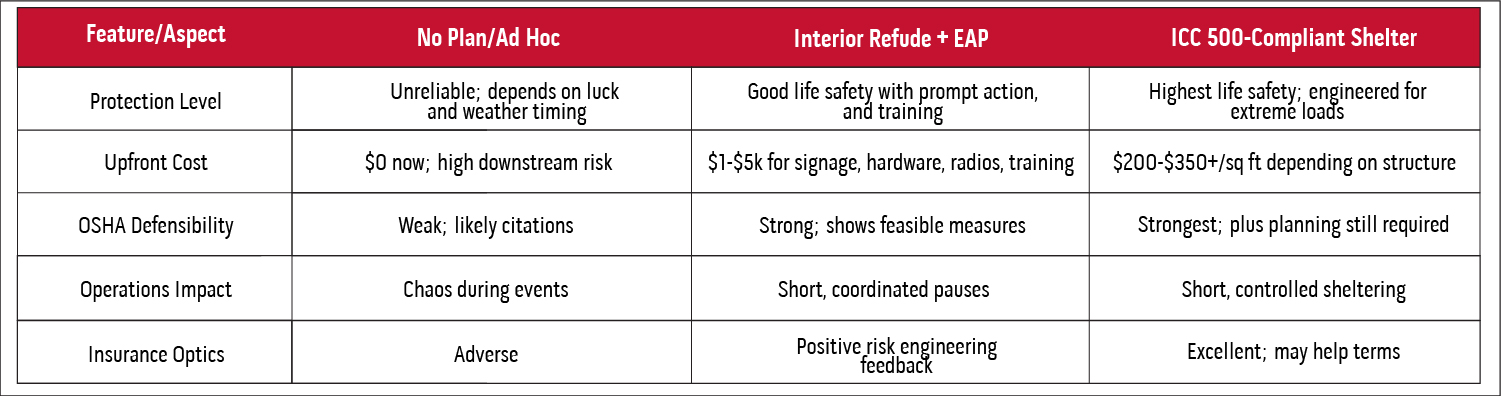
Most businesses win with the middle column quickly. They can decide later if capital budgets allow the for building a fully compliant shelter, like in the right column.
Here’s a simple, order-matters playbook you can implement this month
- Write a tornado annex for the Emergency Action Plan with roles, routes, and refuge rooms, then post maps by time clocks and break areas.
- Add redundant alerts: a monitored NOAA weather radio, plus a mass notification tool or PA procedure with a plain-language script.
- Harden refuge rooms: solid core doors with closers, reinforced frames, a first-aid kit, a flashlight, and posted capacity limits.
- Train supervisors to close or hold front doors during warnings so automatic sliders don’t keep cycling people under glass.
- Run a 10-minute drill per quarter on each shift; sign in, note time to shelter, fix bottlenecks, and file the record.
- Address accessibility: verify wheelchair routes and assign a helper buddy system where needed; no stairs-only paths.
- Coordinate with landlords and staffing agencies so everyone points to the same rooms and scripts.
- After any warning, log a brief after-action note with times, actions, and improvements while memories are fresh.
These steps help protect both large groups and individuals under your care.
If You Operate In A High-Risk Tornado Region
Adopt two-trigger monitoring (NOAA radio plus app), pre-stage key holders near entrances during watch periods, and consider off-hours automated alerts for duty managers. The most vivid example: lights flicker, wind roars like a freight train against the dock doors, and your radio cuts through the noise with a warning. That’s your cue to move bodies, not inventory.
If You Run Large Retail Or Assembly Spaces
Big glass and wide spans demand door control and crowd guidance. Put scripts on lanyard cards for associates. When the PA says, “Please move to the interior hallway marked in green on the signs,” customers follow the green arrows on the floor. Clear, bright arrows beat shouted directions every time. Watch for slip hazards as rain blasts through any door you didn’t secure.
If You Serve Vulnerable Populations Or Critical Services
Dialysis clinics, urgent care centers, and elder care facilities require patient-specific planning. Pre-assign wheelchairs to refuge rooms, store extra oxygen tubing in interior cabinets, and train reception to move paperwork to a later time. If alarms sound while a patient sits mid-treatment, the plan decides in seconds whether to pause and wheel to the refuge room or to finish and shelter in place with added protection. Those choices should not be improvised.
If You Manage Construction Or Temporary Sites, Safety Is Paramount
Trailers, partially enclosed structures, and cranes create unique hazards. Establish “go-to” hard-shelter options nearby and a hard-stop on outdoor work during warnings. That means tools down, lifts lowered, and materials secure. You’ve heard sheet metal flap like a deck of cards in 60 mph gusts; don’t let it turn into shrapnel. Examples of go-to hard-shelter locations: a school, a public building, or a site-built safe area, if available.
✅ FAQ: Do we need an NOAA weather radio if everyone has a smartphone?
A: Yes, keep a dedicated NOAA weather radio for redundancy. Wireless Emergency Alerts sometimes lag or get silenced, and a radio that screams in the breakroom cuts through forklift beeps, music, and phone settings.
Recent Lawsuits Reveal Tornado Shelter Liability for Businesses
Recent tornado lawsuits show a pattern. Liability often hinges on foreseeability, warnings, shelter-in-place direction, door and crowd control—and whether management choices increased exposure relative to safer options inside the building.
Look at high-profile warehouse and retail cases over the past decade, and you see the same fault lines. Plaintiffs point to NWS warning lead times, often around 8–13 minutes, then to actions taken (or not taken). Defense teams do best when they can show time-stamped alerts, PA scripts executed, interior rooms used, and leadership that physically led an evacuation away from glass and long-span roofs and into a safe zone. Code compliance alone rarely ends the argument; juries ask whether managers used the reasonable alternatives available in the moment.
Two Examples: the lessons are clear.
Distribution center, spring evening: a watch becomes a warning while a line of storms pops along the dryline. The safety lead hears the NOAA radio squawk, hits the PA, and you can hear forklifts brake with that high rubber squeal. Supervisors close the front vestibule doors, wave teams into interior corridors, and count heads. Ten minutes later, the building shudders; ceiling dust shakes loose like flour. When the all-clear comes, everyone walks out with white shoulders and wide eyes. OSHA still visits, but the record shows a plan, training logs, and a minute-by-minute response. The outcome? A citation-free closeout and an insurer that keeps favorable terms.
Big-box retail, late afternoon: black-green sky, shopping carts rattling across the lot, and sliding doors that keep opening and sucking damp air across polished tile. Associates keep ringing sales. No announcement. When the gust front hits, a glass panel pops; you can hear the crack before it falls. Two customers slip on wet floors, and another takes a cut on the forearm that needs stitches. Security video shows the warning arriving nine minutes earlier. Plaintiffs ask one question: Why didn’t anyone say, “We’re moving to the back hallway now”?
The lesson in both cases is not about architecture. The lesson is about minutes, scripts, and muscle memory built by drills. And the unpredictable nature of severe weather leaves no room for hesitation.
Pro Tip: Clipboards beat memory under pressure.Print a one-page “storm card” for managers with three boxes:
- Monitor (who/what),
- Move (rooms/routes/doors), and
- Mark (time stamps and headcounts).
✅ FAQ: Does the “Act of God” defense stop tornado lawsuits?
A: Natural disasters do not excuse negligent conduct. Plaintiffs focus on human choices, like ignoring warnings, keeping people under glass, and failing to direct people to shelters. The defense helps only when reasonable steps weren’t possible in the time available.
Numbers matter too. A single serious OSHA citation can cost more than $16,000; a willful classification can exceed $160,000 per item. One customer injury claim can settle in the mid–five figures just to avoid trial. A day of shutdown can burn $25,000–$250,000 in lost revenue and payroll without offset, depending on the operation’s size. Stack two or three of those, and the cost of radios, door hardware, signage, and drills—maybe $3,000 this quarter—looks like the cheapest decision you’ll make all year.
Last point, because it’s the one leaders remember: invisible wins don’t make headlines. The day your PA interrupts the game on the breakroom TV, the sliders stop cycling, that back hallway fills with employees and customers shoulder to shoulder, and you count everyone twice? That’s the day you avoided a lawsuit you’ll never hear about.
Ready to strengthen tornado safety for your employees? Survive-A-Storm Shelters specializes in FEMA- and ICC-compliant shelters designed for businesses. Let’s talk about how we can help protect your employees with the right solution for your organization. Our experts are ready to talk!
Author