

CATEGORIES:
Storm Shelter Compliance: What Businesses Need to Know in 2026
February 18, 2026
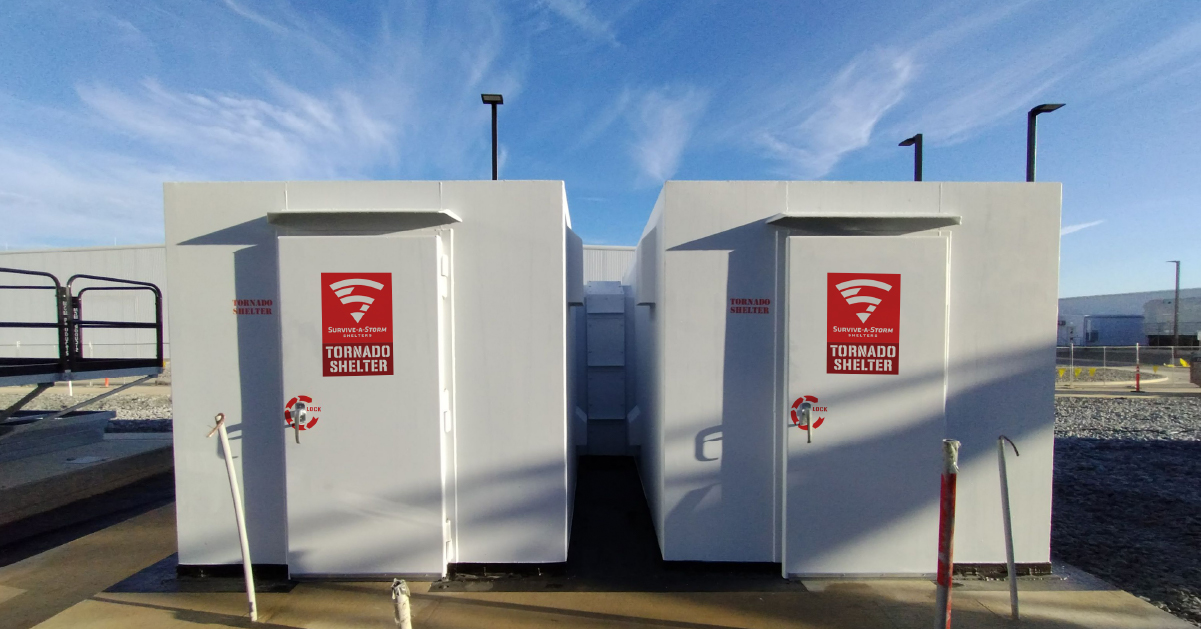
If you ask any business owner in tornado country about tornadoes, they’ll want one thing: a straight yes or no on whether they need a storm shelter. Instead, they get federal guidelines stacked on top of state rules, stacked on top of city ordinances—and none of them quite match up. Plenty of people discover what they're actually required to do halfway through a permit application, sitting in a building department office, realizing their window for cost-effective planning just slammed shut.
Is Your Business Legally Required to Have a Storm Shelter?
People are often surprised by the fact that there's no blanket federal law that says "all commercial buildings must have storm shelters." Business owners in high-risk tornado zones especially don't expect this. Many assume OSHA automatically requires protective infrastructure for worker safety. But just because there's no universal mandate doesn't mean you're off the hook. Your building's purpose, construction date, number of employees, and exact location all create scenarios in which shelter requirements arise unexpectedly during development or renovation projects.
The Short Answer Most Businesses Want
Of course, there is OSHA and FEMA. They publish guidance and design standards, but neither one directly forces private businesses to build shelters. What OSHA actually wants are emergency action plans addressing severe weather—procedures and communication, not physical construction mandates. If you own an existing commercial building you probably won't face retroactive shelter requirements. The exception comes during a major renovation or if you change how you use the space in ways that trigger the current building code review.
The Four Exception Categories
There are four situations that flip the script and create actual legal obligations.
- New construction in high-risk tornado areas. Cities increasingly require shelters when adopting International Building Code provisions that reference ICC 500 standards.
- Schools and daycare centers. These hit lower compliance thresholds in many states. Oklahoma and Alabama pioneered this with statewide requirements after devastating tornado seasons.
- Government buildings and federally funded projects. Shelter specifications are often written directly into contracts, regardless of local codes. Federal money means federal strings attached.
- High-occupancy buildings. Facilities where 50 or more people regularly assemble, like educational or assembly spaces, can trigger enhanced protection requirements when jurisdictions adopt storm shelter rules.
Q: Does OSHA require businesses to have storm shelters?
No, OSHA does not mandate storm shelter construction for most businesses. OSHA requires employers to develop emergency action plans that address severe weather evacuation and sheltering procedures, but these requirements focus on planning and communication rather than on specific building modifications. The OSHA General Duty Clause creates indirect pressure for adequate storm protection in high-risk occupations, but this provision rarely results in specific citations for installing shelters at existing facilities.
The Federal Regulatory Landscape: OSHA, FEMA, and ICC 500
Understanding what separates federal guidance from actual legal mandates is crucial. You don't want to overreact to recommendations, but you also can't afford to ignore compliance obligations. OSHA, FEMA, and the International Code Council each handle different pieces of the storm shelter puzzle. None of them directly requires private commercial buildings to install shelters through federal enforcement mechanisms.
What OSHA Actually Requires
OSHA workplace safety rules require emergency action plans that address severe weather. That includes tornado procedures for getting employees to safety. Check OSHA's emergency preparedness guidance, and you'll see they need you to identify shelter locations and establish communication protocols for severe weather events.
But here's what they don't mandate: building hardened safe rooms or storm shelters. OSHA evaluates whether your existing building spaces provide reasonable protection given your specific workplace hazards and your geographic location. They draw a clear line between preparedness planning (which applies to everyone) and physical infrastructure changes (which fall under building code authority, not federal workplace safety enforcement).
FEMA's Role in Setting Standards
FEMA publishes design and construction standards in documents like FEMA P-361, which reference the ICC 500 standard. These lay out engineering criteria for storm shelters and safe rooms, like technical specs for wind resistance, debris impact protection, and how to calculate occupant capacity.
These standards become enforceable only after state or local governments adopt them into building codes. FEMA can't force private businesses to build shelters. What they do instead is promote shelters through grant programs and mitigation funding. Their focus stays on establishing credible design standards that local governments can reference when writing their own rules.
When State and Local Codes Override Federal Guidelines
State adoption of ICC 500 provisions and local amendments are where you find actual enforceable requirements you need to navigate. The regulatory picture is all over the map. Some states mandate shelters for specific building types. Drive across the state line, and you might find nothing beyond basic building code minimums. Operating across multiple locations or considering expansion into new markets gets confusing fast with this patchwork of requirements.
States with Active Storm Shelter Mandates
Oklahoma passed legislation requiring storm shelters in new school construction following tornadoes that devastated Moore and other communities. Oklahoma HB 2726 established mandatory safe room requirements for public schools, an example that pushed surrounding states to follow suit.
Alabama created similar rules, requiring schools and daycare facilities in high-risk counties to implement measures. Mississippi adopted provisions for new residential care facilities, hospitals, and certain critical emergency operations.
These mandates typically reference ICC 500 design standards and specify which building types and occupancy classifications trigger the requirements. States in Tornado Alley adopt mandatory shelter provisions at much higher rates compared to regions where severe weather occurs less frequently.
How Local Amendments Expand Requirements
City codes often exceed state minimums. They impose shelter requirements on additional categories of commercial buildings by lowering occupancy thresholds, expanding the range of building use types, or eliminating cost-cap exceptions that state codes provide.
To determine what applies to your property, you should verify both state building code requirements and local amendments. State requirements give you the baseline. Local amendments tell you what you really need to do.
Pro Tip: Contact your municipal building department before engaging architects or engineers for project planning. Building officials can identify applicable storm shelter requirements early in the design process when modifications cost significantly less than retrofitting plans that do not include compliant shelter spaces.
Understanding ICC 500 and Building Code Requirements
Think of ICC 500 as a design and construction standard—not a standalone legal requirement. It becomes mandatory only after local building codes adopt it by reference for specific building types or occupancies. When do you run into ICC 500 compliance obligations? During permit applications, when building officials identify applicable code sections that trigger storm shelter provisions.
What ICC 500 Actually Covers
The ICC 500 standard lays out performance criteria for storm shelters. Design wind speeds hit 250 mph. Debris impact resistance accounts for airborne missiles, like 2x4 lumber traveling at 100 mph. Occupant capacity calculations often use 10 square feet per person.
The standard also specifies ventilation requirements to prevent carbon dioxide buildup during extended shelter occupation, structural anchoring to prevent overturning or sliding, and door assembly ratings able to withstand pressure differentials during tornado passage.
Meeting ICC 500 compliance requires coordination among architects, structural engineers, and product manufacturers to verify that all shelter components meet performance specifications. Third-party facilities may be hired to test prefabricated shelter products, confirming compliance with ICC 500 requirements before installation approval.
When Your Building Code References ICC 500
The International Building Code includes provisions in Chapter 4 referencing ICC 500 for specific occupancies, but only when local jurisdictions adopt them. IBC 2021 and later editions contain enhanced storm shelter requirements for educational occupancies (Group E) and daycare facilities in regions with documented tornado risk.
To determine if your jurisdiction adopted these provisions, review the specific IBC edition and local amendments your building department maintains. Some jurisdictions adopt model codes but modify them significantly, excluding storm shelter provisions entirely. Others expand requirements beyond base IBC language, covering additional building types or lowering occupancy thresholds that trigger compliance obligations.
Decision Tree: Does Storm Shelter Compliance Apply to You?
A systematic assessment based on building characteristics and location eliminates most uncertainty about compliance obligations. Start with these questions in sequence:
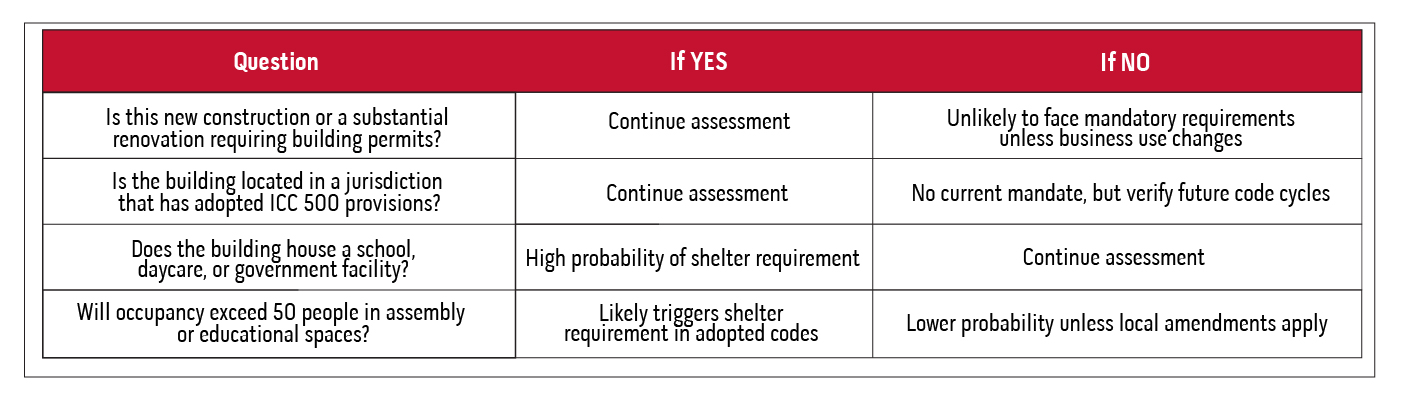
If you own a business in Oklahoma, Alabama, Mississippi, or cities with documented tornado damage history, you should expect that shelter requirements apply to new construction until building officials tell you otherwise. Geographic location within EF3+ tornado probability zones increases the likelihood of local compliance mandates, even where state codes lack statewide requirements.
Key Takeaway: Most existing commercial buildings are not subject to mandatory storm shelter requirements unless they undergo new construction, substantial renovation, or operate as schools or high-occupancy facilities in jurisdictions that have adopted ICC 500 building code provisions.
The Compliance Process: Permits, Inspections, and Following the Guidelines
If you face shelter requirements, you're looking at a multi-step approval process. That will involve architectural plans, engineering calculations, following official guidelines and standards, and inspection milestones. Know this timeline upfront to prevent project delays and budget surprises during construction.
The Permit Application Process
Building permit applications for projects including storm shelters require architect-stamped drawings showing the shelter's location, dimensions, structural details, and occupant capacity calculations. Structural engineers provide sealed calculations demonstrating compliance with ICC 500 for wind loads, impact resistance, and anchoring systems. Product manufacturers submit testing documentation from ICC-ES or other approved evaluation services confirming that the shelter components meet the performance standards.
Plan review timelines stretch when building departments request additional documentation or clarifications on shelter design details. You should budget four to six weeks for initial plan review in most jurisdictions. With complex projects or novel shelter configurations that are not commonly seen by local inspectors, you can expect additional review cycles.
Inspection and Certificate of Occupancy
Construction-phase inspections verify that the shelter installation matches approved plans and meets workmanship standards for structural connections, anchor embedments, and door assembly installation. Inspectors examine foundation work, reinforcing steel placement, concrete strength testing, and wall-to-floor connections during sequential inspection points.
The final inspection verifies that ventilation systems function correctly, door hardware operates as designed, and occupant capacity signage accurately reflects the approved drawings. Getting your certificate of occupancy? That depends on the successful completion of all shelter-related inspections. Compliance verification becomes essential before building occupancy can legally start.
Realistic Cost Ranges for Commercial Storm Shelters
Storm shelter costs vary based on installation type, capacity requirements, and site-specific factors influencing construction complexity. If you have realistic budget ranges upfront you can avoid underestimating project costs during initial planning.
Above-ground safe rooms integrated during new construction typically run between $150 and $300 per square foot for ICC 500-compliant construction. FEMA cost-effectiveness analysis for safe room installations shows that retrofit projects cost 30 to 50 percent more than new-construction integration. Why? Demolition requirements, structural reinforcement of existing buildings, and limited access for equipment and materials all drive up costs. Below-ground shelters can range from $200 to $400 per square foot, depending on soil conditions, water table depth, and accessibility requirements for compliant egress stairs or ramps.
Here are a few site-specific factors that significantly impact baseline costs:
- High water tables. Waterproofing systems and sump pumps can add $15,000 to $30,000 to underground shelter projects.
- Accessibility compliance. ADA-compliant ramps or elevators can double installation costs for underground facilities.
- Capacity requirements. The per-person costs decrease, as shelter size increases beyond the 20-person minimum configurations, creating economies of scale.
- Unforeseen site conditions. Budget contingencies of 20 to 30 percent account for things like unsuitable soils, underground utilities requiring relocation, and structural complications discovered during construction.
Enforcement Reality: What Happens with Non-Compliance
Understanding enforcement mechanisms and consequences helps you assess actual risk versus theoretical penalties outlined in code provisions. How intense is enforcement? It varies dramatically between new construction scenarios and existing building situations.
New Construction Enforcement
Building departments refuse to issue permits for new construction projects that omit required storm shelters in jurisdictions with adopted mandates. Stop-work orders halt construction when inspectors discover deviations from approved shelter plans during building phases. Certificate of occupancy denials prevents businesses from opening facilities that fail final shelter inspections. Both of these scenarios create significant financial pressure to achieve compliance before project completion deadlines.
There could also be monetary penalties for permit violations. They might range from $500 to $5,000 per occurrence, depending on jurisdiction code enforcement fee schedules. Repeat violations can trigger contractor licensing reviews and escalated enforcement actions, including court orders compelling compliance.
Existing Building Liability
Existing buildings rarely face proactive enforcement of shelter requirements unless substantial renovations trigger a current code review. But civil liability exposure increases when tornado-related employee injuries occur in facilities where shelter requirements are in place but not implemented. Workers’ compensation claims may face additional scrutiny when employers fail to provide adequate storm protection in high-risk occupancies.
Insurance coverage disputes sometimes arise when policies exclude claims related to code violations or inadequate safety measures. OSHA citations following tornado incidents can reference General Duty Clause violations—particularly when employers provided no reasonable shelter options despite documented severe weather risk and available protection alternatives.
Q: Can my business be grandfathered out of the new storm shelter requirements?
Existing buildings typically remain exempt from new code requirements until they undergo substantial renovation, change of use, or voluntary upgrades that trigger a comprehensive code review. Grandfathering protects existing facilities from retroactive compliance costs, but businesses lose this protection when renovation costs exceed 50 percent of building value or when occupancy classification changes require permit applications subject to current code provisions.
Where to Get Definitive Answers for Your Jurisdiction
Municipal building departments provide the single authoritative source for determining storm shelter compliance obligations in specific jurisdictions. Building officials identify applicable code editions, local amendments, and occupancy-specific triggers to determine whether shelter requirements apply to particular projects. Schedule pre-application consultations before engaging architects or engineers—confirm requirements and avoid costly design revisions.
State licensing boards maintain directories of structural engineers qualified to perform ICC 500 compliance assessments and shelter design work. Regional FEMA offices provide guidance on grant programs, cost-sharing opportunities, and technical assistance for businesses evaluating shelter options. The International Code Council provides adoption maps showing which IBC editions states have adopted, along with some juridiction-level information. This is helpful for businesses comparing requirements across multiple locations during expansion planning.
Professional engineers with structural specialization can conduct site-specific compliance assessments before formal permit applications. This process identifies potential obstacles and cost factors that influence project feasibility. It's a good idea to document all communications with building officials in writing, creating a paper trail that confirms interpretations of code requirements and compliance pathways for specific building scenarios. This documentation protects businesses when enforcement questions arise during construction or inspection phases, where verbal understandings may get disputed or reinterpreted by different officials.
Whether you're planning new construction, expanding a facility, or evaluating risk exposure across multiple locations, the right shelter strategy starts with early guidance and proven solutions.
Survive-A-Storm Shelters works with business owners, architects, engineers, and municipalities to deliver ICC-500- and FEMA-compliant community and commercial storm shelters that meet code requirements, streamline approvals, and integrate seamlessly into real-world projects. From capacity planning and documentation to installation and inspection support, our team helps you move forward with clarity, confidence, and long-term protection. When safety, compliance, and peace of mind matter, partner with the experts trusted nationwide to get it right the first time. Contact us today!
Frequently Asked Questions about Storm Shelter Compliance?
Where can businesses find the latest storm shelter compliance regulations?
FEMA provides national design guidance, which references ICC 500 performance criteria. The National Storm Shelter Association (NSSA) offers industry-specific guidance and information on membership credentials that are tied to industry standards. State emergency management agencies may publish additional guidance reflecting regional risk and building code adoption trends.
For local regulations, contact your municipal building department first—they're the authoritative source for enforceable requirements. The International Code Council (ICC) also has tools that show which states have adopted specific IBC editions and some jurisdiction-level adoption information, as well as state-by-state code adoption maps. For city-level though, it's still important to contact local municipal building authorities.
What are the key compliance areas businesses need to focus on for storm shelters?
Structural integrity is paramount. Shelters must meet ICC 500 standards for 250 mph wind resistance and debris impact protection. Tornado shelter occupant capacity planning requires specific square feet per person with proper ventilation to prevent carbon dioxide buildup. ADA accessibility standards mandate compliant entry routes, door widths, and egress paths for individuals with disabilities. Third-party testing certification services confirm all shelter components meet performance requirements. Proper anchoring systems prevent overturning or sliding during tornado events.
Where can businesses get professional advice on storm shelter compliance?
Ask your municipal building department about a pre-application consultation to confirm which requirements apply to your specific project. Structural engineers with experience in ICC 500 design can conduct site-specific compliance assessments before you submit your permit application. Regional FEMA offices offer guidance on grant programs and technical assistance. State licensing boards maintain directories of licensed professional engineers. Industry consultants specializing in commercial storm protection can evaluate compliance across different jurisdictions.
Some pre-application consultations are very informal, some cities charge a fee, the details vary by municipality. But there should be someone at that level that will help you interpret local codes.
Where can I report non-compliance of business storm shelters?
Report non-compliance issues to your local building department or code enforcement office—they have the authority to investigate and enforce shelter requirements. For new construction projects, stop-work orders can be issued when shelters deviate from approved plans. OSHA accepts complaints about workplace safety hazards, including inadequate severe weather protection, at osha.gov/workers/file-complaint. State emergency management agencies may investigate complaints about public facilities like schools or government buildings. Document specific concerns with photos and location details when filing reports.
Where in the regulations are occupancy limits addressed for storm shelters?
ICC 500 specifies tornado shelter occupant capacity calculations using a specific square feet per person as the standard. The International Building Code Chapter 4 references ICC 500 for occupancy requirements in educational and assembly spaces when adopted by local jurisdictions. FEMA P-361 provides supplemental guidance on capacity calculations, factoring in shelter duration, ventilation rates, and emergency egress requirements. State building codes may modify these baselines—Oklahoma and Alabama have specific occupancy thresholds triggering mandatory shelter requirements for schools and high-occupancy facilities.
Where do inspections take place for verifying storm shelter compliance?
On-site inspections occur during multiple construction phases: foundation work, reinforcing steel placement, concrete pours, wall-to-floor connections, and door assembly installation. Building inspectors verify shelter installation matches approved architectural plans and engineering specifications. Final inspection confirms ventilation systems function properly, door hardware operates correctly, and capacity signage is posted accurately. Certificate of occupancy depends on the successful completion of all shelter-related inspection milestones. Schedule inspections with your building department at the required construction stages.
Where can training programs be found for employees about storm shelter use?
OSHA requires employers to maintain emergency action plans addressing workplace emergencies, including severe weather procedures. Many businesses develop internal training using OSHA's emergency preparedness guidance. FEMA offers free online courses on shelter operations and emergency management. The American Red Cross provides workplace preparedness training programs customizable for your facility. State emergency management agencies often conduct business preparedness workshops. Consider partnering with local emergency management coordinators for facility-specific drills and training tailored to your shelter configuration.
Author