

CATEGORIES:
FEMA-Approved Commercial Tornado Shelters? What The Term Actually Means
May 14, 2026

You see the term “FEMA-approved” a lot in reference to tornado shelters. Or even FEMA certified. So, what does it mean when a vendor tells you their shelter is "FEMA-approved”? The phrase sounds reassuring. It sounds like a federal inspector showed up, tested the product, and stamped it with government backing.
The reality is that FEMA doesn’t approve or inspect individual shelters and they don’t certify manufacturers. If your goal is to protect your employees and your organization from unnecessary risk, it’s important to understand these claims.
We understand why businesses are searching for FEMA-certified or FEMA-approved commercial shelters, after all, there are a lot of claims out there about FEMA certification or FEMA-approval. It’s reasonable to think that these terms would lead you to tornado shelters that are designed to meet the guidelines of FEMA P-361 and the requirements of ICC 500, which FEMA references.
But the fact is, businesses who are using these terms know that FEMA didn’t certify or approve their shelter. Survive-A-Storm avoids using phrases like FEMA-approved or FEMA certified because they imply a government certification process that doesn’t exist.
In this post, we’ll lay out the meaning behind some of these guidelines and how they carry legal weight in your jurisdiction, what your facility type requires, and how to verify that a vendor’s claims hold up before you sign a contract. Commercial tornado shelters are a significant investment.
What Does FEMA Actually Do In Regard to Tornado Shelters?
FEMA publishes guidance documents for tornado safe rooms, including FEMA P-361, formally titled "Safe Rooms for Tornadoes and Hurricanes: Guidance for Community and Residential Safe Rooms."
So, when a vendor says their shelter is “FEMA approved,” what do they mean? As a consumer, one would hope that they mean that it was designed to meet the published guidance and ICC 500 requirements. But, in reality, language like that can cause confusion, which is why Survive-A-Storm avoids it.
That distinction matters when evaluating vendor claims and reviewing the engineering, testing, and documentation behind a shelter design.
Q: Does FEMA actually test or inspect commercial tornado shelters before approving them?
No. FEMA publishes FEMA P-361, a design and performance guideline that shelters must be designed and engineered to meet. Third-party testing organizations, such as the Texas Tech National Wind Institute, validate shelter designs against those guidelines. FEMA itself does not conduct factory inspections, product tests, or site visits as part of any "approval" process.
What FEMA P-361 Actually Requires
According to the FEMA P-361 4th Edition (2021), a tornado safe room must be engineered to survive a design-basis tornado, which is the worst-case EF5-equivalent wind event the shelter must withstand without structural failure. That threshold is set at 250 mph wind speeds.
The debris impact standard is equally specific. FEMA P-361 requires that shelter walls and doors survive a 15-pound 2x4 lumber projectile traveling at 100 mph. This is not a rough approximation. It is the actual missile impact test condition that shelter components must pass to comply with the guideline. The testing protocols reference ASTM F2247 and ASTM E1996 standards for wall and door assembly impact resistance, giving engineers and buyers a consistent benchmark to compare performance across manufacturers.
Beyond wind and debris, FEMA P-361 addresses structural integrity, ventilation requirements, occupant capacity, and emergency egress. A shelter that meets wind resistance but fails ventilation requirements does not comply with the full guideline.
What FEMA Does Not Do
FEMA does not certify that a shelter was installed correctly on a specific site. FEMA does not maintain a registry of approved shelter products that you can look up. A vendor displaying a FEMA logo on their website or brochure is making a marketing claim, not pointing you to a verifiable government record.
This is the credibility gap that gets facilities managers into trouble. The certification claim looks authoritative. Verifying whether it is accurate requires looking past the logo and into the engineering documentation. We will cover exactly how to do that in the vendor verification section below.
Where Does ICC 500 Come In?
If you’re talking about FEMA guidelines, chances are there will be a reference to ICC 500. ICC is an acronym for International Code Council and the number 500 is the construction standard that sets minimum requirements for shelter design, materials, occupant load, ventilation, and emergency lighting.
Many state and local building codes adopt ICC 500 by reference, making it the legally enforceable standard that building officials, investigators, insurers, and attorneys may reference after a tornado event to evaluate whether the shelter met applicable requirements. FEMA P-361 is a federal guidance document. ICC 500 is adopted law in many jurisdictions. The documents serve different purposes.
Key Takeaway: Facility owners who specify ICC 500 compliance in their shelter contracts establish a minimum performance baseline, while adding FEMA P-361 requirements closes gaps in debris-impact and wind-load protection that ICC 500 alone does not fully address. For full legal and protective coverage, both standards matter.
Where the Two Standards Overlap
Both ICC 500 and FEMA P-361 share core performance requirements for wind resistance and debris impact, and both reference ASTM missile-impact test protocols. A shelter built to FEMA P-361's more demanding criteria will typically satisfy ICC 500 requirements as well. The reverse is not always true. A shelter meeting ICC 500 minimums may not satisfy every FEMA P-361 performance criterion.
How to Know Which Standard Applies to You
Start by checking your state's adopted building code and contacting your local Authority Having Jurisdiction, commonly called the AHJ. The AHJ is the entity, typically your local building department, responsible for interpreting and enforcing adopted codes. Ask directly: “Which version of ICC 500 does your office currently inspect to for tornado shelter permits?” That question will either confirm your compliance baseline or reveal a gap you need to address before construction begins.
Shelter Requirements by Facility Type
There is no single federal mandate requiring all commercial facilities to install a tornado shelter. Whether your organization has a legal obligation and what standard the shelter must meet depends on your facility type, your state's statutes, and your employee population size.
Schools and Educational Facilities
Schools face the most clearly defined obligations, particularly in states that have adopted building code provisions for new school construction. States including Oklahoma, Kansas, Alabama, and Texas have adopted school storm shelter requirements or code provisions tied to tornado safety following major disaster events. These states typically reference FEMA P-361 and ICC 500 as the design standard and specify requirements for capacity, placement, and accessibility for students and faculty. Requirements can vary significantly depending on the state, local code adoption, whether the building is new construction, and the scope of any renovation work.
Schools receiving FEMA Hazard Mitigation Grant Program funds must meet FEMA P-361 and ICC 500 standards as a condition of grant eligibility.
School administrators should consider more than structural compliance alone. Shelter location, accessibility, and the ability to move students and staff into the shelter quickly during an emergency are all important operational considerations.
Warehouses and Large Commercial Buildings
Warehouses and manufacturing facilities don’t face a specific OSHA tornado shelter standard—they face OSHA's General Duty Clause, Section 5(a)(1) of the Occupational Safety and Health Act. This document requires employers to provide a workplace free from recognized hazards likely to cause death or serious physical harm.
In tornado-prone states, a large-workforce facility with no documented shelter plan and no shelter access is an arguable General Duty violation. After a tornado-related injury event, OSHA investigators and plaintiff attorneys will both ask whether shelter access was available, documented, and communicated to employees. The absence of a plan becomes a central fact in that investigation.
Office Buildings and Mixed-Use Facilities
Office buildings typically operate under local building codes and common-law duty of care rather than facility-specific shelter mandates. The important distinction to understand is between a "designated shelter area," such as an interior hallway on the lowest floor, and a code-compliant safe room engineered to FEMA P-361 and ICC 500 criteria.
A designated shelter area is better than nothing. But, in court, it is not the same as a certified shelter. If an employee is killed or seriously injured in an interior hallway during a damaging tornado, and a certified shelter would have survived that event, the difference between those two choices becomes the center of a negligence argument.
FEMA P-361 and Legal Liability
The core question for most facilities managers and business owners researching commercial tornado shelters is this: does having a FEMA-referenced shelter actually protect the organization from legal exposure if someone is hurt? The honest answer is that no shelter certification provides absolute legal immunity. But FEMA P-361 and ICC 500 compliance helps demonstrate that the facility followed recognized shelter standards and took reasonable precautions to protect occupants. By providing a safe place, especially if it’s an official shelter, they kept their employees in the workplace to protect them, rather than sending them home, which could mean driving through the storm.
What "Standard of Care" Means in Court
When a plaintiff attorney evaluates a tornado injury case, the central legal question is whether the facility owner took reasonable, industry-recognized precautions given the known risk–that is the standard of care. A shelter built and documented to FEMA P-361 and ICC 500 is the clearest affirmative answer available to that question. Demonstrating FEMA P-361 compliance may strengthen an employer’s position in negligence claims following a tornado event. Compliance isn’t a guarantee of protection against every claim, but it is the industry standard.
Workers' compensation claims arising from tornado injuries may also be influenced by whether the employer provided access to a designated shelter, particularly in states with established high tornado risk, where the possibility of harm is well documented by NOAA historical data. According to NOAA's Storm Prediction Center, the United States averages approximately 1,200 tornadoes per year, with recent data showing increasing activity across the Southeast and Mid-Atlantic regions beyond traditional Tornado Alley.
Documentation That Strengthens Your Defense
Storm shelters are intended to protect people during some of the worst conditions imaginable. The following documentation showing the shelter was properly designed, permitted, installed, and maintained helps demonstrate that the facility took the responsibility seriously and followed recognized standards if legal questions arise after a tornado event:
- Documentation showing the shelter was reviewed under applicable project and local code requirements
- Engineer-stamped drawings to confirm FEMA P-361 design compliance
- Appropriate entry/exit signage, including posted signage about ADA compliance
- Evacuation drill logs with dates, participant counts, and timing
- Inspection records from a qualified structural engineer (even better if they’re annual)
Each of these documents is evidence that the decision to provide safe shelter was deliberate, professional, and sustained over time.
Pro Tip: Create a dedicated shelter documentation file at your facility and update it annually. Include your permit, engineer-stamped drawings, drill logs, and any inspection reports. If your facility is ever involved in a post-tornado investigation, that file is the first thing your attorney will want to see.
Above-Ground vs. Underground Commercial Shelters
Both above-ground safe rooms and underground shelters can provide high levels of occupant protection when properly designed and installed. The choice between them is often driven by site constraints, accessibility considerations, operational needs, and project requirements. Neither type is inherently more safe than the other, regardless of common beliefs.
Above-Ground Safe Rooms
Above-ground steel-reinforced or cast-in-place concrete tornado shelters built inside or adjacent to an existing structure offer significant practical advantages for commercial facilities. They allow faster occupant entry, eliminating the time required to descend stairs or ladders under warning conditions. ADA-compliant designs are readily available at grade level, meaning wheelchair users and employees with mobility limitations can access the shelter without assistance.
Above-ground safe rooms built to FEMA P-361 anchor and impact-resistance specifications provide equivalent occupant protection to underground shelters while avoiding the flooding, water intrusion, and ventilation challenges associated with below-grade installations. Retrofitting an existing commercial building with an above-ground safe room core is often more cost-effective than excavating for an underground shelter, particularly in facilities built on concrete slabs. However, interior installations may introduce additional fire-rating and code-compliance requirements, depending on the building type and occupancy.
Underground Shelters for Commercial Use
Underground shelters provide strong wind load resistance because surrounding earth absorbs lateral pressure. They are a common choice for large open-land facilities such as warehouses and manufacturing plants where the existing building structure does not offer a practical location for an above-ground safe room.
The engineering challenges for underground commercial shelters are significant, however. High water tables and flooding risk are major concerns across tornado-prone regions of the Gulf Coast and Midwest. ADA access is frequently the most difficult compliance requirement to satisfy in an underground design, as hatches or stairs can exclude wheelchair users entirely without costly secondary accommodations. Drainage, ventilation, and emergency egress must all be addressed in the engineering plan and verified by the AHJ before a permit is issued.
Commercial Tornado Shelter Cost and FEMA Grants
Commercial tornado shelter costs range from roughly $30,000-40,000 for a small above-ground steel safe room serving 20 to 30 occupants and could be up to $500,000 or more for large-capacity underground concrete installations. Most above-ground steel units designed for 50 to 200 occupants fall in the $60,000 to $100,000 installed range. Site preparation, foundation work, and local permitting fees typically add 30% to 50% to the base product cost.
Estimated Commercial Tornado Shelter Costs by Shelter Type
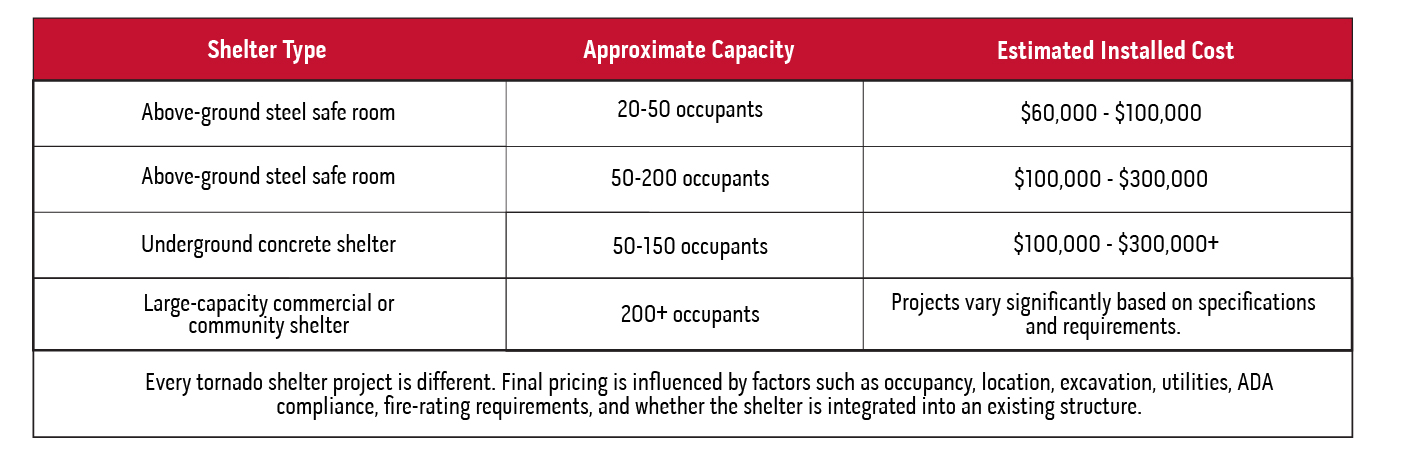
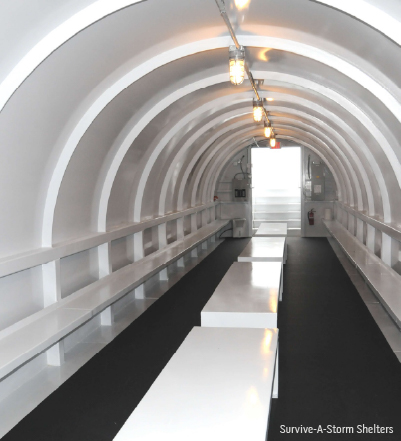
According to ICC 500, community and group shelters must provide a minimum of 5 square feet of floor area per occupant, with additional provisions for shelters serving populations with special needs and to allow for egress and the flow of people. That per-person space requirement is your starting point for calculating what size shelter you actually need, and it directly determines total cost. A workforce of 200 employees requires at least 1,000 square feet of shelter floor space before any other design factors and requirements are applied.
FEMA Grant Programs Worth Knowing
FEMA's Hazard Mitigation Grant Program (HMGP) has funded over 3,000 safe rooms serving more than 1.5 million people, with the federal cost share covering up to 75 percent of eligible project costs. HMGP funds are activated after a presidentially declared disaster and flow through State Hazard Mitigation Offices, meaning you apply through your state agency rather than directly to FEMA.
The BRIC program (Building Resilient Infrastructure and Communities) is FEMA's pre-disaster competitive grant option and is relevant to larger commercial facilities or business parks pursuing shared community shelter solutions. Pre-Disaster Mitigation grants also exist, but are more competitive. Start by contacting your state's FEMA mitigation office to understand which programs are currently funded and open in your region.
How to Verify a Shelter Vendor's Credentials
The most important practical step in this entire process is verifying that a vendor's compliance claims are independently supported before you sign a contract. Marketing materials and website badges are self-reported. The documentation below is how you close the gap between what a vendor claims and what can actually be verified.
Five Questions to Ask Any Vendor
- Can you provide the engineer-of-record's stamped design drawings? A licensed structural engineer must certify that the design meets FEMA P-361 and ICC 500 criteria. No stamped drawings mean no verifiable compliance.
- Has this design been third-party tested to ICC 500 missile impact standards? Reputable vendors have used accredited laboratories such as the Texas Tech National Wind Institute, the NTA or ICC ES. Verify with the manufacturer that such third-party testing has been completed.
- What is the documented per-person capacity under ICC 500 space requirements? The answer must be grounded in the 5-square-foot-per-occupant minimum from ICC 500. (With a 5% subtracted allowance for egress and deductions for fixed items.) Vendors who quote capacity without referencing this benchmark are either uninformed or could be misleading you.
- Are you a member of the NSSA (and at what level)? The NSSA, or National Storm Shelter Association, is a third-party firm that performs a peer review on its members’ shelter units. Producer members of the NSSA will have gone through an application and approval process that involves submitting the engineer-stamped drawings of all of their shelters and submitting the results of their third-party debris impact testing.
Red Flags in Vendor Claims
Vendors who display a FEMA logo but can’t provide engineer-of-record design documentation are making unverifiable claims. Vendors who can’t name the testing laboratory used for their debris impact certification have no independent evidence that the product was tested at all. Vendors who quote occupant capacity without referencing the ICC 500 square footage minimums may be overstating how many people the shelter can legally and safely hold. Remember that manufacturers must use the square footage for commercial shelters, not residential.
These are not just vendor quality issues. If you rely on a non-compliant shelter and someone is injured, the decision to accept unverifiable compliance claims becomes your liability exposure, not just the vendor's. In some jurisdictions and grant programs, shelter designs or documentation may be reviewed as part of permitting or funding approval processes. Buyers should still request engineering documentation and confirm testing directly from the manufacturer.
Q: How do I know if a shelter vendor's FEMA compliance claim is legitimate?
Ask the vendor for the engineer-of-record's stamped design drawings and confirm that the shelter design was tested by a third-party accredited laboratory. A vendor who can’t produce design drawings, won’t confirm they’ve had third party testing, or is not a producing member of the NSSA, has not demonstrated verifiable compliance, regardless of what their marketing materials state.
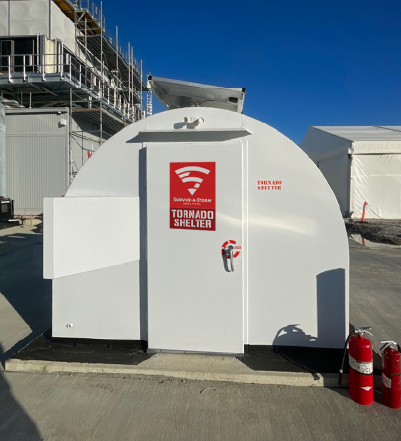
Choosing the right shelter is ultimately about choosing the right partner, one whose compliance claims are backed by documentation, membership in the industry’s leading compliance organization, the National Storm Shelter Association, and who has a track record that is backed by decades of protecting the people and organizations that trust them. Survive-A-Storm Shelters has earned that trust with Fortune 500 companies, military installations, small businesses, school districts, and communities across the country. We don't just meet the standard. We help our clients understand it, document it, and defend it long after installation day.
Frequently Asked Questions About FEMA-Approved Commercial Tornado Shelters
What makes a tornado shelter FEMA-approved?
There is no FEMA approval for tornado shelters. Confirm that vendors design shelters that meet the safety and construction guidelines outlined by the Federal Emergency Management Agency, specifically detailed in FEMA P-320 and FEMA P-361 publications. These shelters must be engineered to withstand extreme wind speeds of up to 250 miles per hour and resist impacts from flying debris, ensuring occupant protection during the most severe tornado events. Key criteria include reinforced concrete or steel construction, secure anchoring to prevent uplift or overturning, adequate ventilation, and sufficient interior space to accommodate a specified number of people safely.
Where can I buy FEMA-compliant commercial tornado shelters?
You can purchase FEMA-compliant commercial tornado shelters from a variety of specialized manufacturers and distributors across the United States. These shelters are designed to withstand extreme wind speeds and flying debris, providing maximum protection for businesses, schools, and public facilities. Many suppliers provide customization options to fit specific building layouts and occupancy needs, along with professional installation services. Additionally, several online platforms now offer direct ordering and consultation, making it easier than ever to obtain a FEMA-compliant tornado shelter tailored to your commercial needs.
How much do commercial tornado shelters that are designed to follow FEMA guidelines cost?
FEMA-compliant commercial tornado shelters typically start at $60,000 and can go into the hundreds of thousands, depending on factors such as size, materials, installation complexity, and additional safety features. Installation costs can also vary based on site preparation requirements and local labor rates. It's important to note that investing in a shelter that meets FEMA guidelines ensures compliance with rigorous safety standards and provides peace of mind during severe weather events.
What size shelters are available for commercial use?
FEMA-compliant commercial tornado shelters are available in a wide range of sizes to accommodate various business needs, from small retail shops to large industrial facilities. Typically, commercial unit occupancy starts 16 occupants, but expansive shelters capable of protecting hundreds of occupants are also available. This range ensures that there are shelters for small offices, restaurants, large warehouses, schools, and even corporate campuses. The dimensions and capacity are carefully engineered to comply with FEMA’s stringent safety standards, ensuring adequate space per occupant for comfort and emergency supplies. Additionally, modular designs allow businesses to customize shelter size and layout based on their specific occupancy requirements and available installation space, making these shelters both versatile and scalable for diverse commercial applications.
Are FEMA-compliant commercial tornado shelters easy to install?
FEMA-compliant commercial tornado shelters are designed with ease of installation as a key priority, ensuring that businesses can quickly and efficiently enhance their safety measures. Most modern shelters come with prefabricated components and comprehensive installation guides, allowing professional contractors to assemble them in a matter of days. Many manufacturers also offer turnkey solutions, including on-site installation services, which minimize disruption to daily operations. Additionally, these shelters are engineered to be compatible with a wide range of building structures, further simplifying the integration process. So, while some technical expertise is required to meet FEMA’s stringent safety standards, the installation process is streamlined and user-friendly, making these prefabricated shelters accessible for most commercial properties.
What materials are used in FEMA-compliant shelters?
FEMA-compliant commercial tornado shelters are constructed using a combination of high-strength materials designed to withstand extreme wind forces and flying debris. The primary materials include reinforced concrete, which provides exceptional structural integrity and impact resistance, and heavy-gauge steel, often used for framing and door assemblies to ensure durability and secure closure during tornado events. Additionally, these shelters incorporate advanced composite panels that enhance blast resistance while maintaining manageable weight for installation. All materials used in FEMA-compliant shelters must meet stringent standards outlined in FEMA P-361 guidelines, ensuring they can endure wind speeds exceeding 250 mph and resist penetration from debris such as lumber and metal fragments. This meticulous selection of materials guarantees occupant safety during the most severe tornado conditions.
Do FEMA-compliant shelters provide protection from debris?
Yes, FEMA-compliant commercial tornado shelters are specifically designed to provide robust protection from flying debris, which is one of the most dangerous hazards during a tornado. These shelters are constructed using reinforced materials such as steel and concrete, and they undergo rigorous testing to ensure they can withstand high-velocity impacts from debris propelled by tornado winds. The design standards set by FEMA require that these shelters meet or exceed criteria for structural integrity and impact resistance, effectively safeguarding occupants from injuries caused by airborne objects. As a result, individuals taking refuge in FEMA-compliant shelters can have confidence that they are shielded not only from extreme wind forces but also from the potentially lethal effects of tornado-borne debris.
Can I customize a FEMA-compliant commercial tornado shelter?
Yes, you can customize a FEMA-compliant commercial tornado shelter to suit your specific needs while still adhering to the rigorous safety standards set by FEMA. These shelters are designed with flexibility in mind, allowing for modifications in size, interior layout, and additional features such as ventilation systems, emergency lighting, communication equipment, and ADA-compliant accessibility options. However, it is crucial that any customization maintains the structural integrity and impact resistance required by FEMA guidelines to ensure maximum protection during severe weather events. Working with commercial tornado shelter manufacturers who are members of the NSSA will help ensure that your customized shelter meets all FEMA guidelines and provides optimal safety for occupants.
Are there grant programs for purchasing these shelters?
Yes, there are several grant programs available for purchasing FEMA-compliant commercial tornado shelters, designed to enhance community safety and disaster preparedness. The Federal Emergency Management Agency (FEMA) offers grants through its Hazard Mitigation Assistance (HMA) program, which includes the Building Resilient Infrastructure and Communities (BRIC) and the Pre-Disaster Mitigation (PDM) grants. These programs provide funding to local governments, businesses, and nonprofit organizations to install tornado shelters that meet stringent FEMA standards. Additionally, some state emergency management agencies have their own grant initiatives aimed at supporting commercial entities in high-risk tornado zones. Applicants typically need to demonstrate the shelter’s compliance with FEMA guidelines and show how it will benefit public safety and resilience efforts.
Author