

CATEGORIES:
Tornado Shelter Installation: What Happens After You Order?
July 23, 2026
One of the common questions we hear in phone calls, live chats, and emails isn't about which shelter to buy. It's about what happens after you buy it.
How long will it take to arrive? Who installs it? Do I need a permit? What do I need to do to prepare? How much does installation cost? Will someone walk me through how it works?
We're going to walk you through the process, from the moment you place your order through the day your installer drives away, when your family has a designated safe place to go.
Step 1: You Place Your Order
Whether you order online, over the phone at 888-360-1492, or through one of our retail partners, like The Home Depot or Lowe’s, the process starts the same way. Once your order is placed, you'll receive an order confirmation email with your order details, shelter model, and next steps. From this point forward, our operations team coordinates everything needed to move your order toward delivery and installation.
Step 2: Your Shelter Goes Into Production
Every unit is manufactured in our factory in Thomasville, Georgia, or Wichita, Kansas, welded by our team, powder-coated for corrosion resistance, and inspected before it ships. We maintain inventory on our most popular residential models. The TwisterPod and the 6x4 Extreme are typically in stock and ready to ship with little wait time, meaning your family can be protected significantly faster than you might expect.
During peak storm season, demand for our most popular models can exceed what we have on hand. If your preferred model is temporarily backordered, you'll receive email updates as your order moves through production, so you always know where things stand.
What to expect during this window: You may not hear from us directly during the production phase unless we need additional information from you, like site photos or permitting details. We send emails to keep you updated on your order status throughout this phase.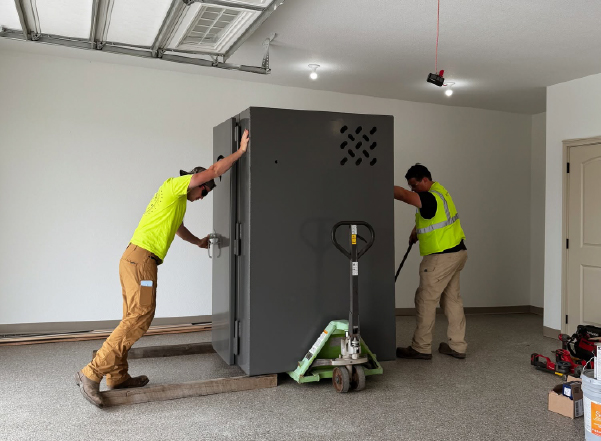
Step 3: Permitting (If Required in Your Area)
Some jurisdictions require a building permit for tornado shelter installation. Whether yours does depends on your specific city or county building department. Survive-A-Storm Shelters offers an optional permitting service that you can add at the time of purchase. If you opt in, our operations team handles the entire permit process on your behalf, including:
- Application
- Documentation
- Coordination with your local building department
If you prefer to handle permitting yourself, we can provide the engineered plans and documentation you'll need to obtain the permit through your local jurisdiction. Either way, you'll have what you need to satisfy your building department's requirements.
For customers who opt into our permitting service, our team will reach out by email, text, or phone to collect a few pieces of information:
- Is your address in the city or county jurisdiction? This determines which building department we submit to.
- Do you have a floor plan for your home? Most counties require this as part of the permit application, and many don't have it on file in their public records.
Once the permit is approved, we'll email you a copy along with any post-installation inspection requirements. In most cases, you'll need to schedule a post-installation inspection with your local building department after the shelter is installed — we'll let you know exactly what's needed and when.
Not every jurisdiction requires a permit. Many residential shelter installations, particularly those bolted to an existing garage slab, do not require a permit. We'll confirm what applies to your specific location early in the process.
Step 4: Delivery Coordination
Once your shelter is ready, our team reaches out to coordinate delivery and installation. The process differs depending on which delivery method applies to your order.
1. Standard Delivery (Carrier Shipment)
For standard shipments, you'll receive an email or text with the proposed shipment date. We'll follow up two days later to confirm. If we haven't heard back from you by the day before the scheduled ship date, your order will be moved to the next available shipment window to avoid sending a shipment you aren’t available to receive. Once shipment is confirmed, you'll receive tracking information so you can follow your shelter's progress from our factory to your address.
2. Flatbed / Hotshot Delivery
For larger shelters or certain delivery routes, your shelter ships via flatbed truck. Our team will call you directly to discuss delivery dates and the number of days the delivery will take.
Important: You will need to arrange equipment to unload the shelter. Flatbed deliveries require a forklift, crane, or other lifting equipment on site at the time of delivery. Our team will let you know exactly what's needed based on your shelter model and weight so you can coordinate the right equipment in advance.
Once confirmed, you'll receive a confirmation email with the shipment date and expected delivery window. Flatbed deliveries do not include real-time tracking; instead, the driver or freight broker will reach out directly with an estimated arrival window as they approach your area.
3. Professional Delivery and Installation
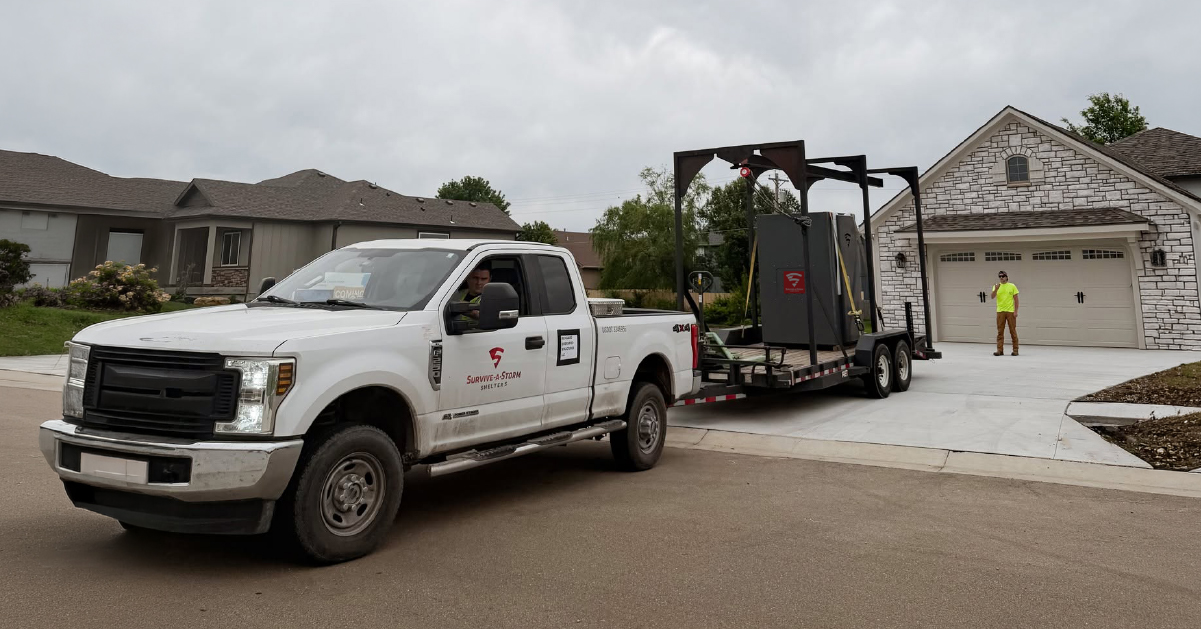
If your order includes professional installation by Survive-A-Storm Shelters, our installation team handles both delivery and placement in a single visit. The team will pull up to your property and back into your driveway to get the shelter as close to the installation location as possible. If driveway access is limited, the team can unload on the street and use a pallet jack to move the shelter into position — through the driveway, into the garage, onto a patio, or wherever the installation will take place.
We leave enough clearance so your vehicles aren't blocked during the process. Our goal is to get the shelter from the truck to its final location with minimal disruption to your property and routine.
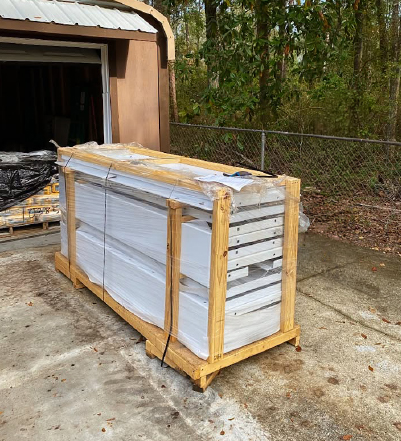
If your order is delivery only (no installation), the shelter will be shipped to your address via carrier or flatbed. You will be responsible for unloading and positioning the shelter at your property. Our team can advise on equipment requirements based on your specific shelter model.
Step 5: Installation Day (Above-Ground Shelters)
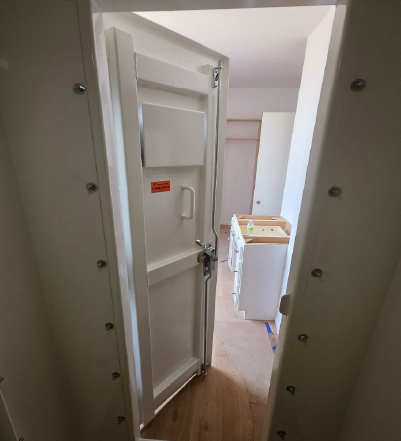
For above-ground residential shelters (TwisterPod, Extreme, and Panelized models), we offer professional installation by our factory-trained teams.
Before the Installers Arrive
Once delivery and installation are scheduled, our operations team will confirm the date with you and provide a time window for the installation crew's arrival — similar to a cable or utility service appointment. Your window might be 8–10 AM, 10 AM–12 PM, or an afternoon block depending on the crew's route that day. We can't guarantee an exact arrival time, but the installers will call you when they're approximately one hour away so you can be home and ready.
What you need to have ready:
A clear path from the driveway to the installation location — whether that's inside your garage, on a patio, or on an exterior concrete pad. The concrete slab where the shelter will be anchored should be accessible and clear of obstructions. If the shelter is going in a garage, make sure vehicles and stored items are moved to create a working area.
The Installation Process
The installation team positions the shelter on the concrete slab, levels it, drills anchor-bolt holes into the concrete, and secures the shelter with high-strength anchor bolts. As an example, the TwisterPod uses 12 anchor bolts with a combined holding power exceeding 55,000 pounds. Every bolt is torqued to specification and documented.
Most residential above-ground installations are completed in a matter of hours — significantly faster than most homeowners expect. The shelter is fully operational the same day it's installed.
The Walkthrough
Our customers consistently mention in their reviews that the walkthrough is one of the most important parts of the process. The installation team will demonstrate:
- How the door opens and closes.
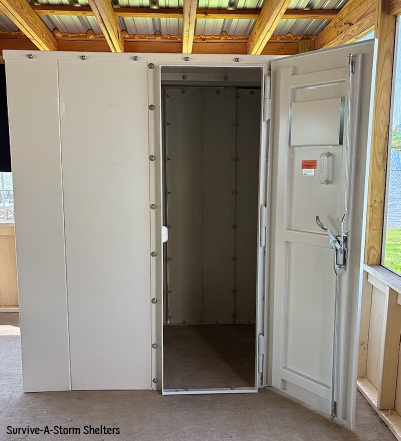
- How the triple-locking mechanism works.
- How to operate the interior release, showing you that it is not possible to be locked in.
- Where the ventilation is.
- Where the escape hatch is located.
- How to use any conduit connections for electrical or communication wiring.
- How the bench seating works and how to store emergency supplies.
They'll answer every question you have and make sure every family member present understands how to get in, lock the door, and get out.
The installers will also have you sign an installation log that captures your geo-location information and confirms the installation was completed to manufacturer specifications. This document becomes part of your permanent shelter documents file.
A Note on Payment
All balances, including the shelter cost and installation fee, must be paid in full before the unit is offloaded from the truck. Your sales representative will coordinate payment before installation day, allowing the installation team to focus entirely on setting up your shelter and walking you through its operation.
Step 6: Below-Ground Shelter Installation (Estate and GarageCube)
For below-ground shelters (the Estate and the GarageCube), the installation process works differently.
Survive-A-Storm manufactures and delivers below-ground shelters, but we do not install them. Below-ground installation requires excavation, concrete work, and site-specific knowledge of drainage, soil conditions, utilities, and local building codes that are best handled by a local professional who knows your area.
We recommend working with a reputable general contractor or septic company in your area. These professionals have the excavation equipment, soil expertise, and familiarity with local codes to install the shelter correctly and safely.
Before any excavation begins, you are responsible for calling 811 — the national "Call Before You Dig" hotline. This is a free service that sends utility locators to your property to mark the location of underground gas, electric, water, sewer, cable, and communication lines. Digging without calling 811 first can result in serious injury, service disruptions, and significant fines. Most utility locators will mark your property within 2–3 business days of the request. Schedule this well before your contractor's planned excavation date.
What we do provide: We coordinate delivery of the shelter to your property, provide detailed installation specifications and instructions, and can speak directly with your chosen contractor to walk them through the requirements and answer technical questions. We want your installer to have everything needed before they break ground.
For the Estate model
Installation involves excavating an opening in your yard, lowering the shelter into the prepared space, backfilling with soil, and finishing the grade-level entry. A general contractor or septic company can typically complete the installation in 2-4 hours once the excavation is prepared.
For the GarageCube model
Installation involves cutting and removing a section of your existing garage concrete slab, excavating beneath it, lowering the shelter, backfilling with concrete, and finishing the lid flush with the garage floor. This is a more involved process — typically 8-14 hours in an existing home, or about 3 hours when incorporated into new home construction before the slab is poured.
For detailed installation specifications on both below-ground models, see our underground tornado shelter installation guide.
Step 7: After Installation — What Comes Next
Your shelter is installed. Your family knows how to use it. Now what?
Post-Installation Inspections
If your installation required a building permit, you'll need to schedule a post-installation inspection with your local building department. Our team will have already provided you with the inspection requirements and contact information. Most post-installation inspections are straightforward; the inspector verifies the shelter is anchored per the engineered specifications and confirms the permit is complete.
Warranty Registration
Make sure your shelter is registered with Survive-A-Storm Shelters for warranty coverage. If you performed a self-installation (delivery only, no professional install), you'll need to provide interior and exterior photos of the completed installation for warranty verification.
Annual Maintenance
Above-ground shelters are mostly maintenance-free, but we recommend an annual check: inspect for any surface rust, verify door operation and locking mechanism, confirm anchor bolts are secure, and check ventilation openings. Once a year, take updated photos of the interior and exterior and submit them to Survive-A-Storm Shelters to maintain your warranty.
Practice with Your Family
Creating a tornado emergency plan is the step most people skip, and it's arguably the most important one after the shelter is in place. Walk your family through the process at least once. Everyone in the household should know where the shelter is, how to open the door, how to lock it from inside, and how to exit through the escape hatch if the primary door is blocked.
If you have pets, practice getting them into the shelter. If you have young children, make the shelter feel familiar rather than scary. The families who practice are the families who act fastest when a real warning comes.
When Should I Purchase a Tornado Shelter?
The single most important takeaway: the process starts when you order, not when storm season starts. Families who order in January or February have their shelters operational well before peak tornado season. Families who wait until the first watch is issued are ordering into peak demand, when lead times are longest and installation schedules are fullest.
What Does Tornado Shelter Installation Cost?
Installation pricing for above-ground residential shelters depends on your shelter model and your distance from our nearest installation team. As a general reference point, above-ground installation starts at approximately $500 plus mileage for your area.
For an exact installation quote for your specific shelter and location, call 888-360-1492 or chat here with a representative. Our team can typically provide a quote within minutes based on your city and state.
Below-ground installation costs vary more significantly because they depend on your local contractor's pricing, soil conditions, equipment requirements, and any permitting fees in your jurisdiction. We recommend getting quotes from two to three local contractors or septic companies for below-ground installation.
Ready to Start the Process?
The best time to order a tornado shelter is before you need one. Storm season doesn't wait, and neither do lead times. If you've been researching and you're ready to move forward, here's how to start:
Shop residential shelters: survive-a-storm.com/residential-storm-shelters/
Call us: 888-360-1492. We can walk you through model selection, sizing, installation options, and financing in a single conversation.
Not sure which shelter is right? Call us and tell us how many people you need to protect, where you want to install it, and whether you prefer above-ground or below-ground. We'll recommend the right model for your family and your space.
Frequently Asked Questions About Tornado Shelter Installation
How long does tornado shelter installation take?
Most above-ground residential tornado shelter installations are completed in a matter of hours once the shelter arrives. Below-ground installation timelines vary depending on the model, site conditions and your local contractor's schedule.
Do I need a permit to install a tornado shelter?
Permit requirements vary by city and county. Some jurisdictions require a permit, while others do not. Survive-A-Storm offers an optional permitting service or can provide the documentation needed if you obtain the permit yourself.
Who installs my tornado shelter?
Survive-A-Storm professionally installs above-ground residential shelters. Below-ground shelters can be installed by a general contractor or a septic company, as excavation and site preparation vary by location.
What should I do before installation day?
Before installation, make sure the installation area is accessible and clear of vehicles or stored items. If you're installing a below-ground shelter, remember to contact 811 before excavation begins.
Can I install a tornado shelter myself?
Above-ground shelters can be delivered without professional installation, but proper anchoring is essential. If you choose self-installation, follow the manufacturer's instructions and provide the required documentation for warranty verification.
How much does tornado shelter installation cost?
Above-ground installation varies, but starts at approximately $500 plus mileage, depending on your location and shelter model. Below-ground installation costs are performed by local contractors, so would be quoted directly by the installer.
When should I order a tornado shelter?
Ordering before storm season helps avoid peak demand and gives you more flexibility for scheduling production, delivery and installation.
Author